Essential oil blending for cosmetic bases requires more than choosing a pleasant fragrance. It combines aromatic chemistry, formulation technique, skin-safety knowledge, and careful documentation. The central question is how to blend essential oils into cosmetic bases without destabilizing the product or irritating the user.
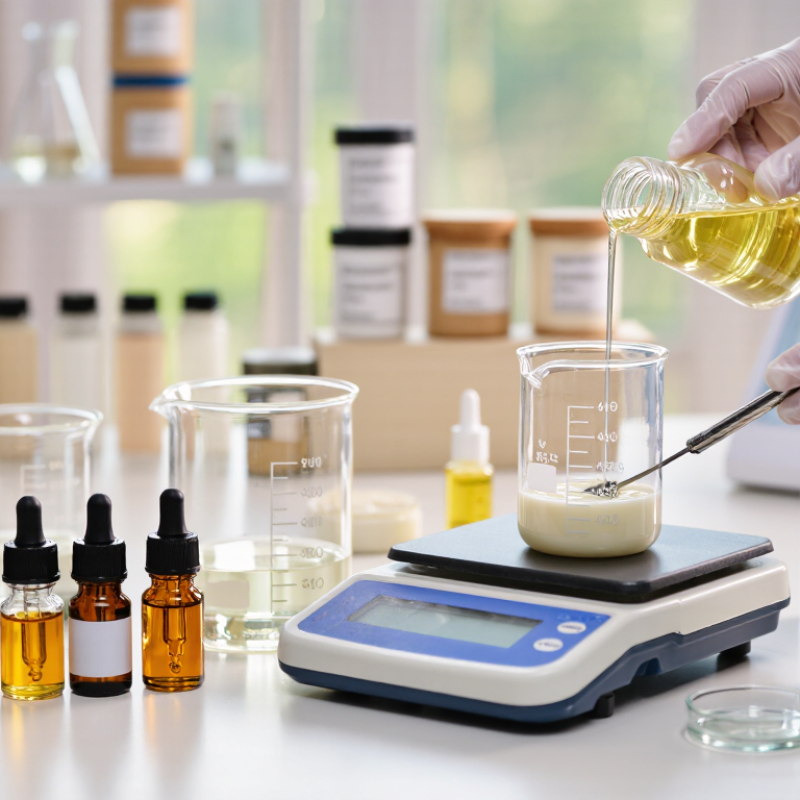
Robert Tisserand, a recognized essential-oil safety educator, states, “Natural does not mean safe.” This reminder matters at the workbench. A lavender note may smell gentle, yet its concentration, oxidation level, and application area still require attention. Essential oils should be measured by weight, not counted by drops. A digital scale improves repeatability. It also exposes mistakes.
A practical blend begins with a compatible base, such as a cream, balm, body oil, or shampoo. Check whether the formula can disperse aromatic materials evenly. Some oils need a suitable solubilizer. Others may separate, cloud the product, or alter its texture. Add the essential-oil blend slowly, while stirring at a controlled temperature. Record every ingredient, percentage, batch number, and observation.
Skin compatibility cannot be assumed. Follow reputable dilution guidance, supplier safety data, and applicable cosmetic requirements. Consider sensitization, phototoxicity, allergies, and leave-on exposure. Perform stability checks, packaging reviews, and properly designed user testing before wider release. A small sample may look perfect on day one, then change after heat, light, or several weeks.
There is no universal recipe. That is the uncomfortable part. A formula suitable for a body oil may fail in a facial cream. Good blending depends on evidence, restraint, and repeated evaluation—not simply a stronger scent.
Definition and Purpose of Essential Oil Blending in Cosmetic Bases
Essential oil blending for cosmetic bases means combining selected aromatic oils with a prepared cream, lotion, balm, or carrier oil base. Its purpose is more than adding fragrance. A carefully designed blend can create a balanced scent, support the product’s sensory identity, and improve the user’s application experience. Each essential oil has different volatility, aroma strength, and skin tolerance. The final blend must suit the base and its intended use.
In practice, formulation starts with small measured amounts and clear batch records. Essential oils should be diluted appropriately because they are highly concentrated plant extracts. A formulator checks whether the oils remain evenly dispersed, especially in emulsions and water-rich products. Heat, light, and oxygen may also change their aroma over time. A pleasant aroma can still irritate skin. The boundary is not always obvious.
Reliable development includes ingredient specifications, stability observation, and a review by a qualified cosmetic safety professional. Applicable cosmetic regulations and recognized fragrance-safety guidance should shape the usage level. Patch testing can provide useful information, but it cannot guarantee universal tolerance. Even careful formulas can need revision. I would not treat a successful home trial as proof of professional safety. Citrus oils, floral oils, and resinous oils may behave very differently in the same base. A restrained blend is often more practical than a powerful one.
Calculating Safe Dilution Rates and Blend Proportions
What Is Essential Oil Blending for Cosmetic Bases?
Essential oil blending means dispersing aromatic oils through a suitable cosmetic base. The safe rate depends on the product type, application area, and user. A face cream usually needs more caution than a body wash. Children, pregnancy, sensitive skin, and damaged skin require professional guidance. Some oils may also increase sun sensitivity.
Calculate dilution by weight whenever possible. For a 30-gram finished product at 1%, use 0.3 grams of essential oil and 29.7 grams of base. The formula is simple: essential oil weight ÷ total product weight × 100. A 0.5% blend would contain 0.15 grams in 30 grams. Drops are convenient, but drop size changes between bottles. A digital scale gives better control. Check current safety data and applicable cosmetic standards for each oil.
Blend proportions also affect texture and stability. Add the essential oil slowly, then mix until no oily streaks remain. Some bases need a compatible solubilizer. Without one, the oil may separate and touch skin unevenly. My early test batches looked smooth at first, then separated overnight. That mistake changed my process. I now check the mixture after one day, one week, and temperature changes. Keep written records of oil amounts, batch weight, skin area, and observed irritation. A small patch test helps, but it cannot guarantee universal safety.
What Is Essential Oil Blending for Cosmetic Bases? - Calculating Safe Dilution Rates and Blend Proportions
Illustrative leave-on cosmetic dilution calculations using a conventional estimate of 20 drops per millilitre
| Cosmetic Application |
Common Starting Range* |
Base Quantity |
Target Dilution |
Essential Oil Quantity |
Example Blend Proportion |
Safety and Formulation Notes |
| Facial serum or facial oil |
0.5–1% |
30 g |
0.5% |
0.15 g
≈ 0.15 ml
≈ 3 drops |
Lavender: 50%
Frankincense: 30%
Cedarwood: 20%
|
Use low concentrations for facial leave-on products. Confirm the dermal limit of every individual oil before use. |
| Body lotion or body cream |
1–2% |
100 g |
1% |
1 g
≈ 1 ml
≈ 20 drops |
Lavender: 50%
Sweet orange: 30%
Frankincense: 20%
|
Add the essential oil blend during the appropriate cool-down phase and mix thoroughly for even distribution. |
| Massage oil |
1–2% |
50 ml |
2% |
1 ml
≈ 20 drops |
Lavender: 40%
Sweet marjoram: 30%
Cedarwood: 20%
Frankincense: 10%
|
Avoid eyes, mucous membranes, damaged skin, and areas exposed to strong sunlight when phototoxic oils are present. |
| Hand cream or body balm |
0.5–1% |
100 g |
1% |
1 g
≈ 1 ml
≈ 20 drops |
Lavender: 40%
Frankincense: 30%
Cedarwood: 20%
Roman chamomile: 10%
|
Patch-test the finished product. Frequent hand washing and damaged skin can increase irritation risk. |
| Small trial batch |
Formulation test |
30 g |
3% |
0.9 g
≈ 0.9 ml
≈ 18 drops |
Oil A: 50% = 9 drops
Oil B: 30% = 5–6 drops
Oil C: 20% = 3–4 drops
|
A 3% level is not a universal safe limit. Use only when the specific oils, intended users, product category, and applicable standards support it. |
Calculation method: Essential oil quantity = total cosmetic base × target dilution rate. For example, 100 g × 1% = 1 g of essential oils. The drop estimates are approximate because drop size varies with oil viscosity, temperature, dropper design, and density; weighing is more accurate for production.
Important safety note: These are general starting ranges for adult leave-on cosmetic products, not legal maximums or universal safety limits. Check the applicable cosmetic regulations and the current safety guidance for each individual essential oil. Expressed bergamot, expressed lime, and some expressed lemon oils may present phototoxicity concerns; use a suitable non-phototoxic material or follow the specific permitted concentration for the intended product.
|
Blending, Testing, and Incorporating Essential Oils Properly
What Is Essential Oil Blending for Cosmetic Bases?
Blending essential oils for cosmetic bases requires more than creating a pleasant scent. The oil must suit the product type, intended use, and skin contact time. Leave-on creams need greater caution than rinse-off cleansers. Start with a precise formula and weigh every ingredient with a calibrated scale. Drops are not reliable enough.
In practice, I blend essential oils into a small portion of the base first. This helps reveal separation, cloudiness, color changes, or an uneven aroma. Essential oils do not dissolve naturally in water. A suitable solubilizer or emulsifying system may be necessary. Add the blend slowly, then mix under controlled conditions. Keep the temperature low when the formula allows it.
Test before scaling up. Check appearance, odor, pH, viscosity, and stability over time. A sample should also undergo appropriate preservative and microbial testing. Review current safety documentation and usage limits for every oil, including possible sensitizers and phototoxic constituents. Skin patch testing can identify some reactions, but it cannot replace a professional safety assessment. Never assume a natural ingredient is automatically gentle.
The difficult part is often the scent balance. A blend may smell elegant on day one, then become sharp or dull after storage. I still find that first impressions can mislead. Record each revision, including the disappointing ones. Those notes often explain why a formula changes later.
Storage, Stability, and Safety Considerations for Finished Products
Essential oil blending for cosmetic bases requires more than a pleasant scent. The finished product must remain stable, safe, and consistent during storage. Heat, oxygen, light, and moisture can accelerate oxidation, especially in citrus and delicate floral oils. A cream may look unchanged while its aroma and skin tolerance decline.
Store finished products in tightly closed, light-resistant containers. Keep them in a cool, dry area, away from windows and radiators. Wide jars invite repeated air exposure and wet fingers. Pumps or sealed tubes often provide better protection. Record the batch date, formula, essential oil percentage, packaging type, and storage conditions. Small details matter.
Test samples under normal and stressful conditions. Check color, odor, texture, separation, and pH at planned intervals. Microbiological testing remains essential for products containing water. A preservative system should be professionally assessed, not guessed from scent strength. Essential oils are concentrated materials; natural origin does not guarantee safety. Review dermal limits, sensitization risks, phototoxic potential, and the needs of sensitive users. Use a qualified safety assessor and follow current cosmetic regulations in every target market.
It is tempting to trust a successful small batch. That can be misleading. Different harvests, containers, and temperatures may change performance. Some stability decisions still involve uncertainty, so document failures honestly and improve the formula before wider use.
Essential Oil Blending for Cosmetic Bases: Storage, Stability, and Safety
Essential oils are generally more vulnerable to oxidation when exposed to heat, oxygen, and light. Finished products should be evaluated in their final packaging, with attention to the formula’s water content, antioxidant system, preservative effectiveness, and essential-oil concentration. The risk scale below is qualitative and should be confirmed through appropriate stability and safety testing.
Conclusion
Essential oil blending in cosmetic bases is the controlled process of combining aromatic plant extracts with creams, lotions, balms, oils, or other personal-care formulations to add fragrance and selected sensory benefits. Learning how to blend essential oils into cosmetic bases requires choosing oils that suit the base’s texture, ingredients, and intended use, while considering solubility, scent strength, and potential skin sensitivity. A balanced formula should use conservative dilution rates and carefully calculated blend proportions rather than relying on aroma alone.
Successful blending involves thoroughly mixing the essential oils with a suitable dispersing or carrier component before incorporating them into the cosmetic base. Small test batches should be evaluated for scent, texture, separation, color changes, and skin compatibility through appropriate safety testing. Finished products should be stored in tightly closed, light-resistant containers away from heat and moisture. Clear labeling, batch records, freshness monitoring, and responsible use guidance help maintain product stability and reduce the risk of irritation or unintended reactions.

 Mirae Biology