Sunlight can quietly change a chemical’s color, strength, purity, and performance. The key question is: why do chemicals degrade in sunlight? Usually, ultraviolet radiation supplies enough energy to break molecular bonds or trigger unwanted reactions. Some substances undergo photolysis, while others react with oxygen and form new compounds. Heat from direct sunlight can accelerate these changes.
A practical prevention strategy begins with understanding the material. Review its light sensitivity, storage guidance, and available stability data. Then select protection suited to the chemical, such as opaque containers, UV-resistant packaging, or controlled indoor storage. Keep containers tightly closed. Oxygen and moisture may worsen light-driven degradation. A cool, dry cabinet can make a visible difference.
Test the solution, not just the container.
In laboratory and manufacturing settings, professionals often compare samples stored in darkness with samples exposed to controlled light. They may monitor color, concentration, pH, odor, or impurity levels over time. This evidence is more dependable than assuming a dark bottle provides complete protection. Packaging can develop scratches, labels can fade, and brief exposure during handling still matters. No single barrier works perfectly.
Reliable control also requires clear records, appropriate safety data, and validated testing methods. Follow the supplier’s instructions and relevant quality standards. Avoid transferring sensitive chemicals into unsuitable containers. It is tempting to focus only on sunlight, but temperature, oxygen, moisture, and contamination may contribute equally. The best approach is careful, evidence-based, and occasionally skeptical of convenient assumptions.
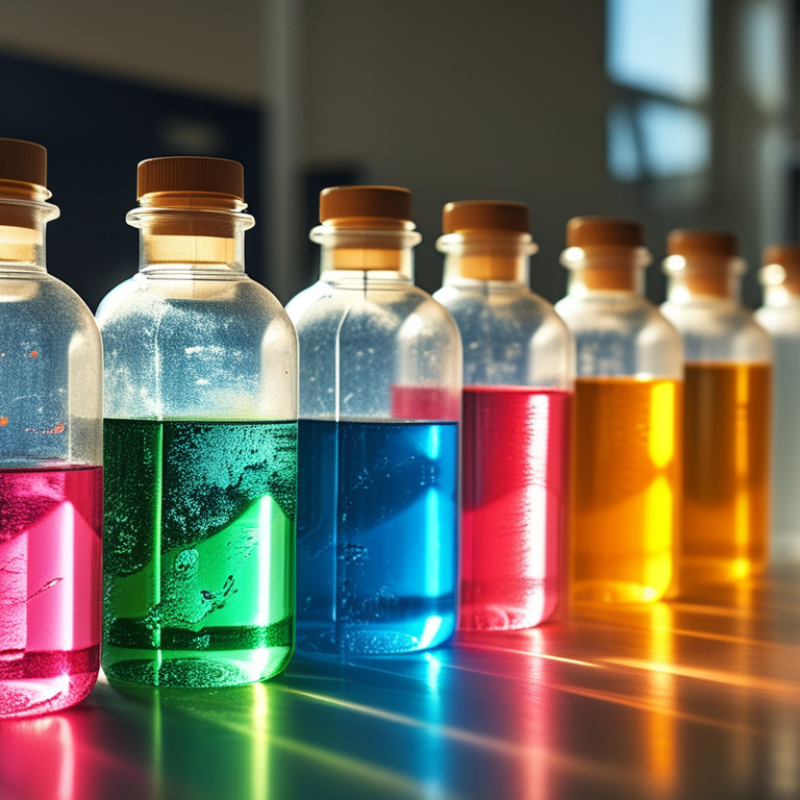
Sunlight can change chemicals before any visible color shift appears. Ultraviolet energy can break chemical bonds, especially in molecules that absorb light strongly. It is photolysis. Visible light may also trigger reactions in sensitive compounds. Sunlight warms containers, which can accelerate oxidation and evaporation. Oxygen and moisture often amplify the damage. A clear bottle offers little protection. Risk depends on wavelength, exposure time, temperature, and chemical structure.
Use opaque or amber containers when the formulation permits. Choose materials after checking their light-transmission data. Store containers away from windows, lamps, and hot surfaces. Keep closures tight, because oxygen can enter during repeated opening. Smaller containers can reduce headspace and limit exposure after opening. For sensitive solutions, validated light-protection studies should compare protected and exposed samples. Measure color, potency, pH, and degradation products over time. These tests reveal damage that appearance alone can miss.
Some materials surprise us. A container may block ultraviolet light while transmitting visible wavelengths. That detail is easy to overlook. I would verify storage assumptions with real-time and accelerated testing, rather than relying on guesswork. Accelerated heat testing is useful, but it may not reproduce sunlight chemistry. Results need cautious interpretation. If a solution darkens, develops particles, or changes odor, hold it for evaluation. Do not rely on smell alone. These observations should support laboratory testing, not replace it.
| Sunlight or Environmental Factor | How Chemical Degradation Occurs | Typical Chemical Consequence | Practical Prevention Measure | Important Considerations |
|---|---|---|---|---|
| UVA radiation 315–400 nm |
UVA can be absorbed by a chemical or by a photosensitizer. The excited molecules may then undergo bond cleavage, electron transfer, or reactions with oxygen. | Loss of active compound, formation of oxidation products, discoloration, or reduced performance. | Use opaque or UV-protective packaging, minimize light exposure, and validate the selected material with photostability testing. | UVA can pass through ordinary window glass more readily than UVB, so indoor storage is not automatically light-free. |
| UVB radiation 280–315 nm |
UVB has higher photon energy than UVA and can directly break susceptible chemical bonds or initiate radical reactions. | Photolysis, structural rearrangement, fragmentation, and loss of chemical potency. | Use opaque containers, UV-blocking secondary packaging, and closed storage away from direct sunlight. | Most UVB is absorbed by ordinary window glass, but direct outdoor exposure can be substantially more damaging. |
| Visible light Approximately 400–700 nm |
Some colored or conjugated molecules absorb visible light and enter reactive excited states. | Fading, bleaching, oxidation, or changes in composition even when UV exposure is limited. | Use light-resistant, opaque, or appropriately tinted packaging and control exposure during filling, sampling, and use. | A package that blocks UV may still transmit visible wavelengths; packaging suitability depends on the compound’s absorption spectrum. |
| Oxygen and photo-oxidation | Light-generated excited states can transfer energy or electrons to oxygen, producing reactive oxygen species such as singlet oxygen and radicals. | Oxidation of sensitive functional groups, impurity growth, odor changes, and reduced shelf life. | Reduce headspace oxygen where appropriate, use inert-gas blanketing or oxygen-control systems when compatible, and select suitable antioxidants only after testing. | Oxygen-control methods must be compatible with the chemical, container, safety requirements, and intended use. |
| Photosensitizers and impurities | Trace dyes, metal ions, peroxides, or other impurities may absorb light and transfer energy to the target chemical or oxygen. | Unexpected degradation at light levels that would not directly excite the main compound. | Control raw-material purity, remove catalytic contaminants where feasible, and evaluate the complete formulation rather than only the active ingredient. | Small amounts of impurities can have a disproportionate effect because photosensitized reactions may be catalytic or chain-propagating. |
| Temperature rise caused by sunlight | Solar absorption can heat the container and accelerate thermal reactions. Temperature may also increase the rate of light-driven reactions. | Faster hydrolysis, oxidation, isomerization, evaporation, or decomposition. | Store in a cool, temperature-controlled location, avoid hot vehicles and direct sun, and use reflective or thermally protective secondary packaging when needed. | A container can remain light-protected but still overheat; temperature monitoring may be necessary for sensitive materials. |
| Water and humidity | Water can participate in hydrolysis and may increase molecular mobility in solids. Humidity can also affect packaging and formulation stability. | Hydrolytic breakdown, caking, crystallization changes, or increased reaction rates under illuminated conditions. | Use moisture-resistant, well-sealed packaging and control humidity during storage and handling. | Desiccants are not universally suitable; they must be selected according to the material’s safety and compatibility requirements. |
| Packaging transparency | Transparent containers allow some combination of UV and visible light to reach the chemical. | The degradation rate depends on the container’s spectral transmission, wall thickness, geometry, and exposure duration. | Select packaging based on measured spectral transmission and confirm protection using the final container configuration. | Tinted or amber-colored packaging may reduce light transmission, but performance varies by material and wavelength. |
| Exposure duration and intensity | Photochemical change generally increases with the amount of effective radiation absorbed, although the relationship may not be strictly linear. | Progressive assay loss and increasing concentrations of photoproducts. | Limit exposure time, reduce unnecessary opening or sampling, and use controlled lighting during processing. | Season, latitude, altitude, weather, orientation, and surface reflectance can change real-world exposure. |
| Photostability testing | Controlled testing identifies whether light causes chemical change and distinguishes photodegradation from heat-, oxygen-, or moisture-driven effects. | Quantified changes in active concentration, degradation products, appearance, pH, or other relevant quality attributes. | Test the chemical in its final formulation and final package, using dark controls and temperature controls where appropriate. | A protection strategy should be based on analytical results rather than color alone or assumptions about indoor lighting. |
: Conjugated molecules, aromatic compounds, colored dyes, and weak carbon–halogen bonds may absorb light strongly. Peroxide-forming substances also require careful review. Structure matters.
Sometimes. A pale solution may become yellow, cloudy, darker, or unexpectedly faded. However, an acceptable appearance does not prove stability. Odor is unreliable and should not replace analysis.
Review the safety data sheet, storage instructions, and known absorption range. A UV-visible scan can identify strong absorption near the available light source. Controlled comparison tests may help, but validated analysis remains important.
Amber glass suits some light-sensitive liquids when chemically compatible. Opaque plastic may work for other materials. Check compatibility before transferring anything.
Use a cool, dry cabinet away from windows, skylights, heaters, and ultraviolet equipment. Keep containers tightly closed and clearly labeled. Darkness alone is insufficient.
Inspect for cloudiness, crystals, swelling, leaks, fading labels, or liquid color changes. Air, moisture, heat, and container materials may also affect stability. A dark bottle is not a guarantee.
Brief daily exposure can accumulate over several weeks. Record the light source, distance, exposure time, and container orientation. Temperature spikes may accelerate light-initiated reactions.
Use small, light-resistant portions when repeated opening is unavoidable. Keep caps closed and reduce headspace where appropriate. Returning a warm container directly to cold storage may cause condensation.
It can reveal patterns that memory misses, including long lighting periods or warm storage. Still, a neat log cannot repair poor sampling or weak analysis. Records help.
Sunlight can gradually alter chemicals through ultraviolet and visible radiation, triggering reactions that break molecular bonds, change color, reduce potency, or create unwanted by-products. Understanding why do chemicals degrade in sunlight is the first step toward preventing damage. Substances such as dyes, pharmaceutical ingredients, fragrances, polymers, and other light-sensitive compounds may be especially vulnerable, so their stability should be assessed before storage or use.
Protection begins with light-blocking containers and cool, shaded storage locations away from windows and direct illumination. Exposure time should be minimized during transport, measurement, and handling, while excessive heat and repeated temperature changes should be avoided because they can accelerate degradation. Where appropriate, compatible stabilizers may help slow light-induced reactions, but they must be selected carefully to avoid affecting chemical performance. Regular checks of appearance, odor, concentration, and other relevant quality indicators can reveal early changes and support timely replacement or corrective action.

 Mirae Biology